


In short
- An open is recorded when a tracking pixel loads, and Apple Mail loads pixels before anyone reads.
- Roughly half of recorded opens across the market now come from Apple Mail.
- That makes open rate a measure of your audience’s device mix as much as their interest.
- Benchmark articles published this year still quote B2B open rates above 40% as if they were measured.
- Reply rate, click-to-open, meetings booked and cost per meeting survive the change. Open rate does not.
- Ask any agency reporting to you what their reply rate is, and watch what happens.
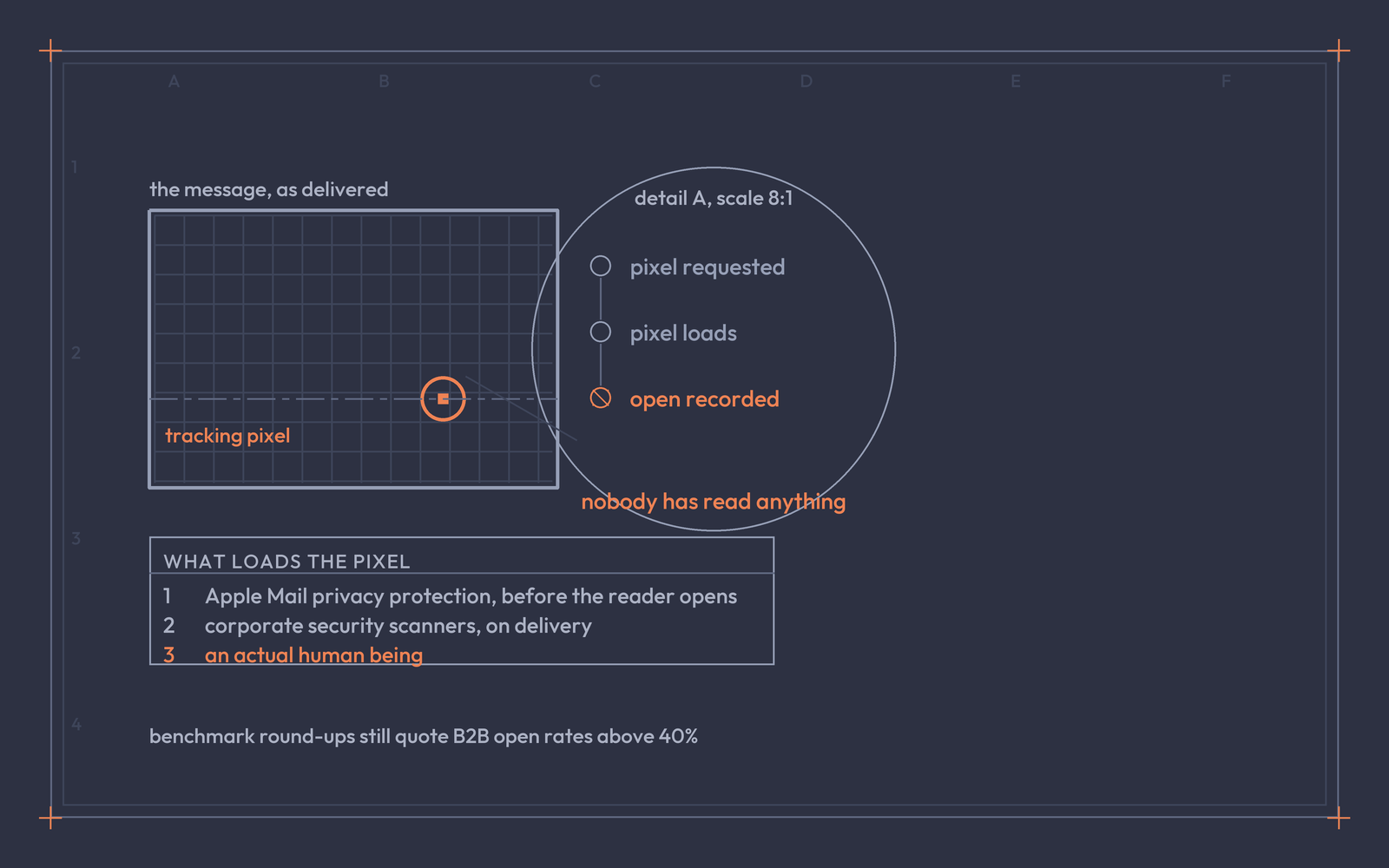
What an open rate actually measures
An email open records one thing: a one-pixel image loading from a server. No human being has to be involved.
That was a reasonable proxy for a long time. It stopped being one when Apple introduced Mail Privacy Protection, which pre-loads remote images on Apple’s own infrastructure before the recipient opens the message. The pixel fires. The open is recorded. Nobody has read a word.
Vendor benchmark data now puts Apple Mail at roughly half of all recorded opens. Whatever number your platform reports, a large share of it describes Apple’s servers rather than your buyers.
Why the benchmark articles are worse than useless
Search for B2B email benchmarks and you will find open rates quoted above 40%, published in 2026, presented as measurements.
Those figures are arithmetically correct and practically meaningless. They are averages of a number that includes machine opens, drawn from senders with different audience device mixes, compared against your number which has a different mix again.
The failure mode this produces is specific and expensive. A team sets an open rate target. They test subject lines against it for a quarter. The number improves, so the tests are judged successful, when the improvement came from a shift in who was on the list and what devices they use.
Worse, open rate can be improved by sending to a smaller, more engaged group, which is often the right thing to do for other reasons. The metric rewards the action and then takes credit for it.
What to use instead
Four numbers survive the change, and a finance director recognises all of them.
Reply rate. A human being typed something back. It cannot be faked by an image loading, it correlates with intent, and it is the number an outbound programme should be judged on.
Click-to-open, calculated on clicks. If you want an engagement ratio, build it from clicks rather than opens. Clicking requires a decision.
Meetings booked. The output the business actually wanted. Slower to accumulate and much harder to argue with.
Cost per meeting. Total programme cost divided by meetings produced. This is the number that lets someone compare email against paid media honestly, and it is the reason database work usually wins that comparison.
The uncomfortable version for agencies
Open rate is the most flattering number in email marketing, which is why it leads so many agency reports.
It is high, it responds to small changes, and it requires no cooperation from the client’s sales team. Reply rate is lower, harder to improve, and depends partly on whether the offer is any good. Meetings booked exposes whether the whole thing worked.
If you receive a monthly report that leads on open rate, ask two questions. What was the reply rate, and how many meetings came from this. A supplier who cannot answer either has been measuring the easy thing.
We apply that to ourselves. Positive reply rate is the number we report on, because it is the part we control, and meetings booked sits next to it because that is the part the business cares about.
Rebuilding a monthly report around three numbers
If you want to change your reporting this month, the shortest version has three lines.
- Positive reply rate, by segment, with the previous period next to it.
- Meetings booked from email, with the source campaign named.
- Cost per meeting, including the tooling and the people.
Everything else, including open rate, goes in an appendix for anyone who wants it. Keeping it visible is fine. Leading with it is the problem.
Questions, answered
So open rate is completely useless? It has one remaining use. A sudden collapse in recorded opens often signals a deliverability problem rather than a content problem, because it can mean mail stopped arriving. Watch it as an alarm, rather than as a performance measure.
Our audience is mostly on Outlook, not Apple. Does this still apply? Less so, and the reasoning still applies. Your open rate is now a function of your audience’s device and client mix, which makes it incomparable with any published benchmark and with any other company’s number.
What is a good reply rate for B2B? Published ranges vary widely by list quality and offer, so an external benchmark tells you little. Your own previous quarter is the comparison that means something.
Can we still A/B test subject lines? Yes, and test them against clicks or replies. Testing against opens measures which subject line made Apple’s servers fetch an image, which is the same answer every time.
Does this change how often we should send? It changes how you decide. Without a trustworthy open rate, cadence has to be set by unsubscribe rate, complaint rate and reply rate. Those are the three that still mean something.
Sources
- Apple, Mail Privacy Protection, product documentation.
- Apple Mail share of recorded opens: vendor benchmark, Instantly, 2026. Vendor data, quoted as such.
- B2B open rate benchmarks above 40%: Powered by Search, WebFX and Brevo benchmark round-ups, 2026. Cited as examples of the problem rather than as evidence.
This is one part of a bigger picture. Start with our guide to B2B email marketing for the whole sequence.