

In short
- A score sales did not help define is a score sales will ignore, whatever the model does.
- Score against what closed, rather than against what engaged.
- Fit and intent are separate axes. Collapsing them into one number destroys the information.
- Negative scoring is the half most teams skip, and it is where the false positives come from.
- A score with no time decay describes who was interested last year.
- The working test: sales can predict which leads the model will send them next week.
The reason scores get ignored
Most lead scoring models fail for a reason that has nothing to do with the model.
Marketing builds it. Marketing defines what a point is worth. Marketing announces that leads above a threshold are now sales-ready. Sales receives a queue of leads it had no part in defining, works a few, finds them poor, and goes back to its own list.
After that the score is dead, and no amount of retuning revives it, because the problem was never the weights.
The fix costs one meeting and is unpopular because it is slow. Before anything is built, sales and marketing agree in a room on what a good lead looks like, using real examples from the last twelve months. Not a definition in the abstract. Ten actual records, discussed one at a time, with both sides saying whether they would have worked it.
The model that comes out of that meeting has a sponsor in the room that has to act on it.
Score against what closed
The most common design error is scoring engagement because engagement is easy to measure.
Opening an email is a behaviour of the curious as much as the interested. Downloading a whitepaper is often a student, a competitor, or someone doing research they will never act on. Attending a webinar is closer, and it still tells you less than firmographic fit does.
The honest way to build a score is backwards. Take the deals that closed in the last year. Look at what those contacts did before they became opportunities. Weight those behaviours. Ignore the ones that appear just as often in the deals that went nowhere.
This produces an uncomfortable result in most companies: a handful of behaviours carry almost all the predictive value, and most of the tracked activity carries none.
Fit and intent are two different questions
A single score answers two questions at once and therefore answers neither.
Fit is whether this company is the kind you sell to. Size, sector, geography, technology, structure. It changes slowly and it is knowable before any behaviour occurs.
Intent is whether this person is doing something about a problem right now. It changes quickly and it means nothing without fit.
Collapsing them hides the difference between a perfect-fit account showing mild interest and a poor-fit account behaving enthusiastically. Those two leads deserve opposite treatment, and a single number gives them the same score.
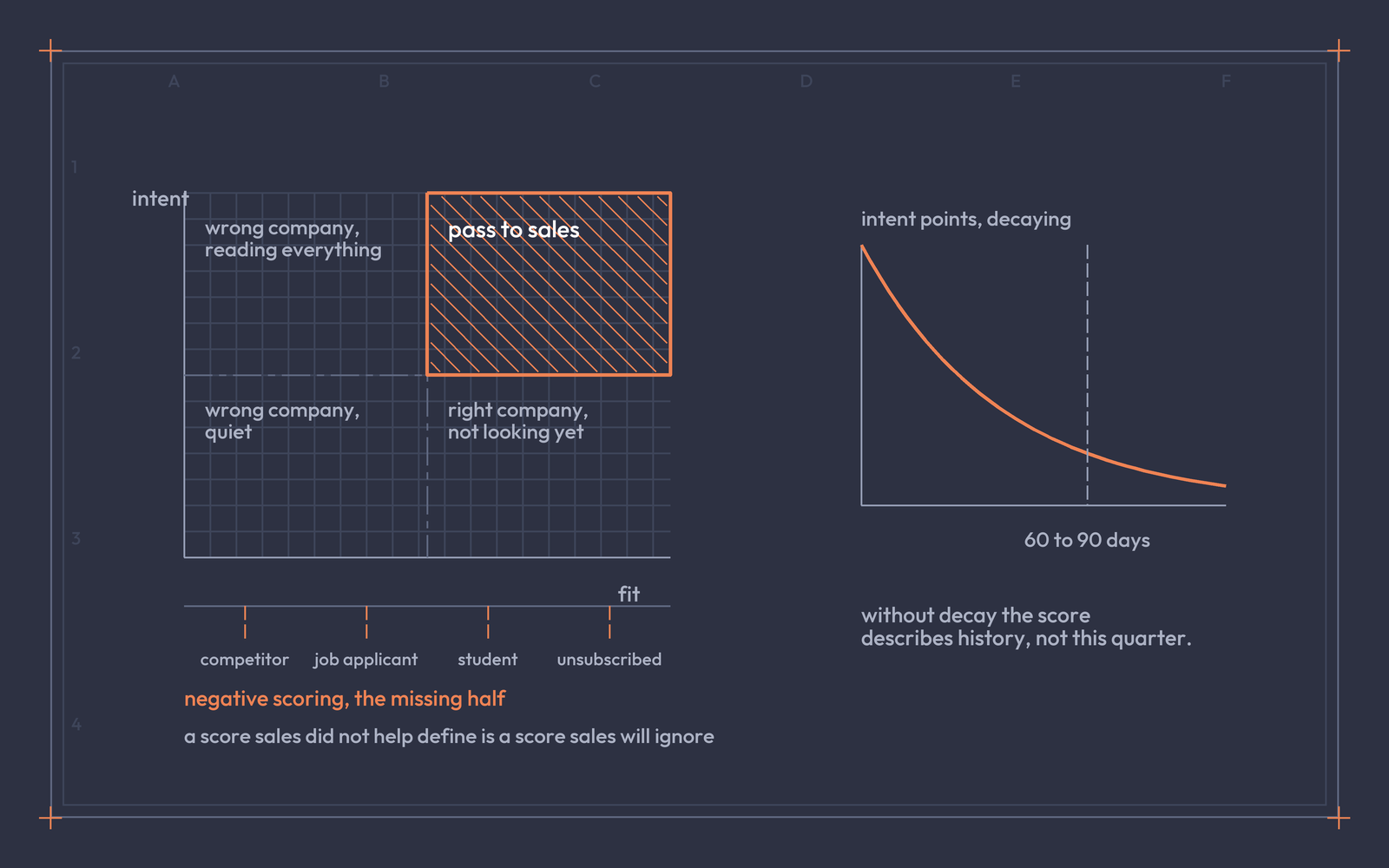
Keep them as two axes, and route on the combination. High fit and high intent goes to sales today. High fit and low intent goes to nurture. Low fit and high intent goes to nurture at lower priority, or nowhere.
Negative scoring is the missing half
Almost every model adds points. Few subtract them, which is why sales queues fill with obvious non-buyers.
Subtract for:
- Competitors. By domain, and keep the list current.
- Job applicants. Careers page visits and CV attachments are strong signals of something other than buying.
- Students and researchers. Free email domains combined with education-sector signals.
- Existing customers, unless you are scoring for expansion, in which case they belong in a separate model entirely.
- Contacts who have been rejected by sales before. Without this, the same lead is served up repeatedly and the score loses credibility fast.
A model that only adds points will eventually score everyone highly, because activity accumulates.
Time decay, or the score describes history
Interest is perishable. A contact who researched heavily eight months ago and has done nothing since is not the same as one who did it last week, and an undecayed score cannot tell them apart.
Apply decay to intent, not to fit. Company size does not go stale in the same way that a pricing page visit does.
The practical version: intent points expire after a defined window, usually 60 to 90 days in B2B. Fit attributes persist until the underlying data changes.
The test of a working score
Here is the only test that matters, and it takes five minutes.
Ask a salesperson to predict, without looking at the system, which kinds of leads the model will send them next week.
If they can, the model reflects a shared understanding and they will work the queue. If they cannot, the model is a private opinion belonging to the marketing team, and it will be ignored no matter how sophisticated it is.
What to change when the score and reality disagree
Review quarterly against closed-won data.
If the score predicted well, tighten the threshold and route more. If it did not, the usual cause is one of three things: a behaviour weighted too heavily because it was easy to track, a missing negative rule, or a fit definition that describes the customers you want rather than the ones who buy.
Change one thing at a time, or you will not know which change worked.
Questions, answered
Do we need AI or predictive scoring? Not to start. A rules-based model built from your own closed-won data outperforms a sophisticated model nobody trusts. Consider predictive scoring once you have enough closed deals for a model to learn from, which is more than most mid-market companies have.
How many points should the threshold be? Whatever produces a queue sales can actually work in a week. Set it by capacity first, then tune.
Should marketing or sales own the score? Jointly defined, and owned by whoever is measured on what happens after the handover. If nobody is measured on that, fix that first.
What if we have no closed-won data to learn from? Then start with fit only, route on it, and add intent once you have enough outcomes to test against. A fit-only model is honest about what it knows.
How often should the model change? Quarterly at most. A score that changes monthly gives sales no chance to build trust in it.