


In short
- Three separate studies get merged into a single claim across most articles on this subject.
- The 391% figure comes from Velocify, around 2013. It is vendor research.
- The 21x figure comes from MIT and InsideSales.com, 2007.
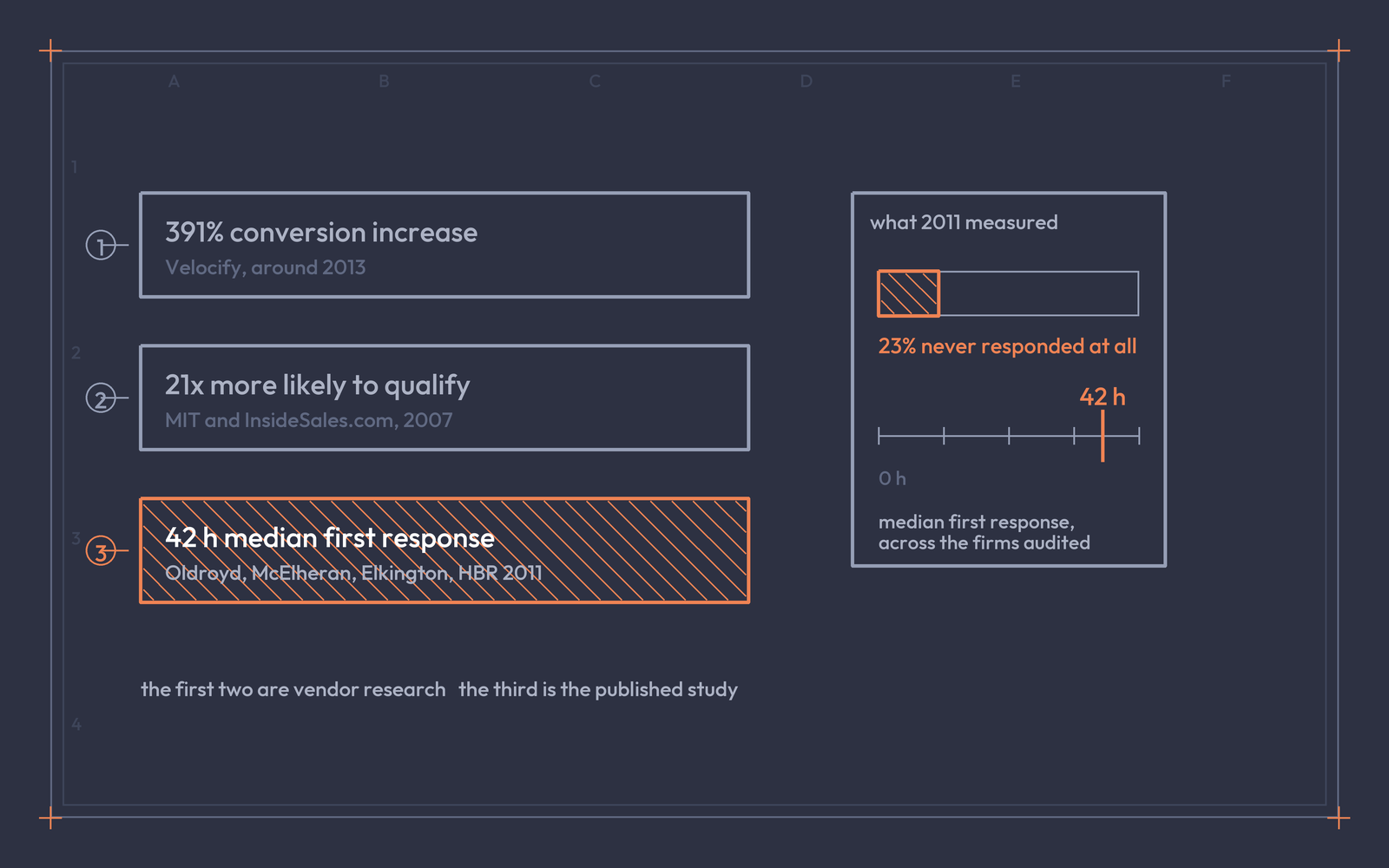
- What Harvard Business Review actually published in 2011 is different, and worse for the firms in it: a median first response of 42 hours, and 23% that never responded at all.
- The three findings support different actions, so quoting the wrong one produces the wrong fix.
- Before changing anything, measure your own median first response time. Few teams have.
The claim you have read a hundred times
Somewhere in the last month you have probably read that Harvard Business Review found calling a lead within 60 seconds increases sales by 391%.
It is a good line. It is repeated by sales tooling vendors, by agencies, and in a 39-minute video on email marketing from Alex Hormozi that has been watched more than 680,000 times.
Harvard Business Review did not publish that number.
What has happened is that three different pieces of research, conducted years apart by different organisations with different methods, have been compressed into one sentence. The percentage came from one of them. The prestige came from another. Repeat that often enough and the two fuse.
This matters more than pedantry, because the three studies point at three different problems.
Where each number actually comes from
The 391% figure: Velocify, around 2013
The 391% conversion increase from calling within one minute traces to research published by Velocify, a lead management software company, across roughly 3.5 million leads from more than 400 companies.
That is a large sample. It is also vendor research, conducted by a business that sells software for contacting leads faster, with no published peer review. Use it if you want, and say where it came from.
The 21x figure: MIT and InsideSales.com, 2007
The finding that contacting a lead within five minutes rather than thirty makes you 21 times more likely to qualify it comes from the Lead Response Management study, led by Dr James Oldroyd, then at MIT, with InsideSales.com.
Note what it measures. Odds of qualifying a lead, rather than revenue or a sales increase. A qualified lead is a long way from a closed deal.
The Harvard Business Review contribution: Oldroyd, McElheran and Elkington, 2011
The genuine HBR article is “The Short Life of Online Sales Leads”, published in 2011 by James Oldroyd, Kristina McElheran and David Elkington.
Its headline findings are not percentages at all. Across the firms audited, the median first response time was 42 hours. And 23% of the companies studied never responded to the enquiry at all.
Almost a quarter of firms, receiving an enquiry from someone who raised their hand, and answering nobody.
Why the mix-up produces the wrong fix
Take the three findings apart and they ask for different things.
The Velocify number is an argument about call speed. If you accept it, you buy dialler software and you change the rota so somebody is always available.
The MIT number is an argument about qualification windows. If you accept it, you change what happens in the first thirty minutes, which is a workflow question rather than a staffing one.
The HBR finding is an argument about whether anyone responds at all. If you accept it, the first thing to fix is coverage. There is no point optimising the first sixty seconds of a process that, for a quarter of enquiries, never starts.
Most teams reading the merged version buy the dialler. The HBR finding suggests a large share of them should have started by working out which enquiries currently receive no answer.
Which one we use, and why
We cite the HBR finding.
Partly because it is the only one of the three that went through academic review at a named institution and was published by a title a chief financial officer recognises.
Mostly because it is the more useful fact. A percentage lift invites an argument about whether your business is average. “Twenty-three per cent of firms never responded” invites a different question, which is whether you are one of them. That question can be answered this week, from your own data, without buying anything.
In one anonymised engagement with a B2B software client, the enquiries that had received no human response inside five working days ran into the hundreds across the previous year. Nobody in the business had ever counted them, because no report existed that would show a lead nobody had touched. The absence of the number was the reason the problem survived.
Measure your own, this week
You do not need a study to know whether this applies to you. You need four numbers from your CRM.
- Median time from enquiry to first human response. Median, not average, because a handful of instant replies will flatter an average badly.
- The proportion of enquiries in the last twelve months with no logged human response at all. This is the HBR number, calculated on your own data.
- The same figure split by source. Enquiries from a form, a webinar and an event usually receive very different treatment, and the gap is where the process is broken.
- The proportion that received exactly one attempt. One attempt and silence is a common pattern, and it looks identical to “worked” in most dashboards.
If number two comes back above zero, that is where the money is, and it costs nothing to recover beyond deciding who owns it.
Questions, answered
Is the 391% figure wrong? Not necessarily. It is vendor research with a large sample, and it may well describe something real. What is wrong is attributing it to Harvard Business Review, which lends it authority it was never granted.
Does speed to lead apply in B2B, with long sales cycles? The response window matters most where the buyer is actively comparing options, which is usually the moment they filled in your form. A long overall cycle leaves the first hour just as important, because it is the only hour where you are the one they are thinking about.
We respond in a day. Is that fast enough? It is faster than the 42-hour median in the HBR study. Whether it is fast enough depends on what your competitors do, which you can test directly by submitting their forms.
Who should own first response? Whoever can be measured on it. The common failure is that response sits between marketing and sales, so it belongs to neither and no report covers it.
What if the enquiry is unqualified? Then it still needs a response and a route. An unqualified enquiry that is answered and filed correctly costs a minute. One that is ignored stays in the database as a contact nobody will ever work.
Sources
- Oldroyd, J., McElheran, K. and Elkington, D. (2011) “The Short Life of Online Sales Leads”, Harvard Business Review.
- Lead Response Management study, Dr James Oldroyd with InsideSales.com, 2007.
- Velocify lead response research, c.2013. Vendor research.
- Sabnis, G., Chatterjee, S. C., Grewal, R. and Lilien, G. L. (2013), “The Sales Lead Black Hole: On Sales Reps’ Follow-Up of Marketing Leads”, Journal of Marketing, 77(1), 52-67. DOI 10.1509/jm.10.0047.