

In short
- Nurture is designed around one contact. The purchase is made by a group. Everything follows from that.
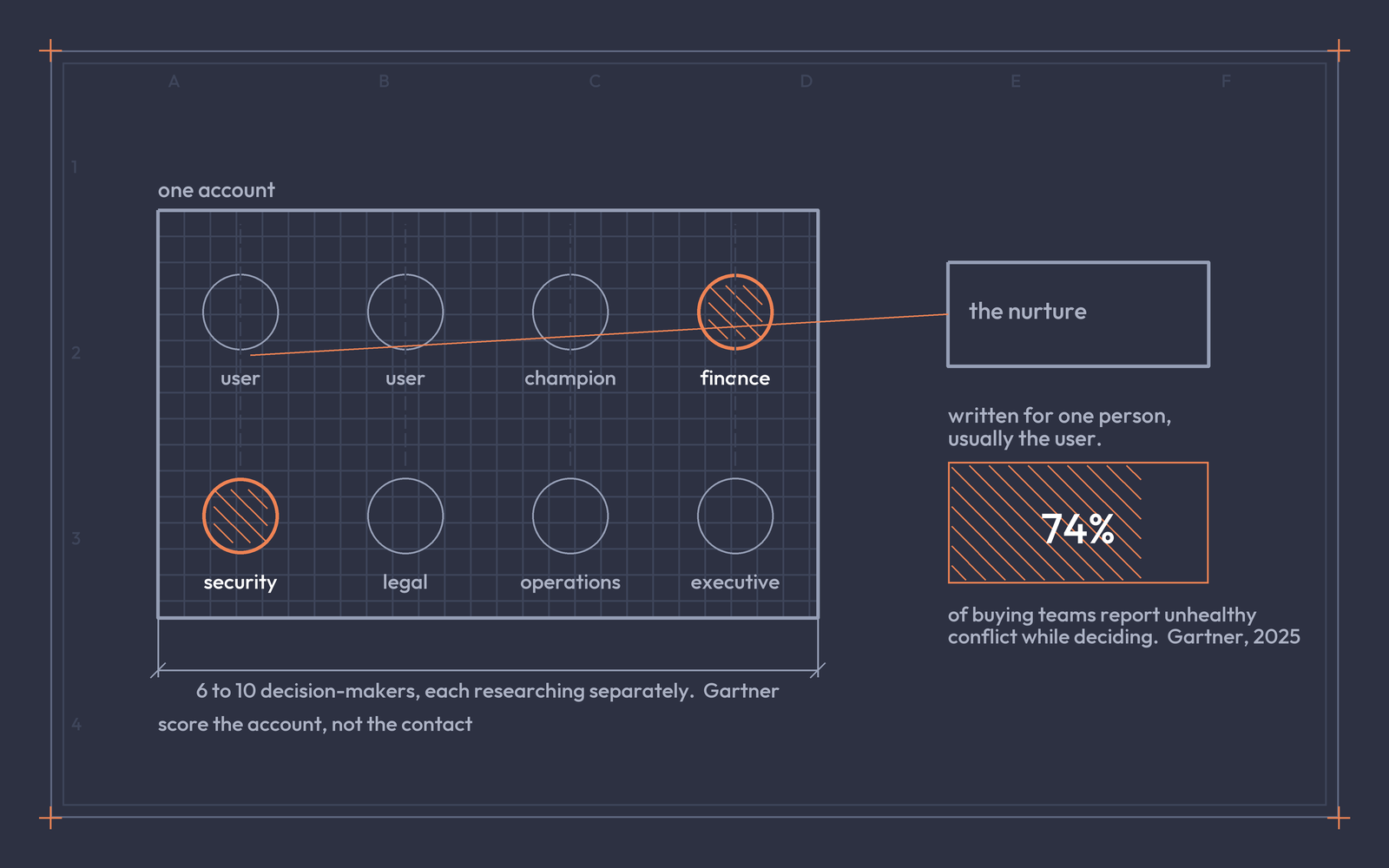
- Gartner puts the average B2B purchase at 6 to 10 decision-makers, each researching separately.
- Gartner’s 2025 sales survey reports 74% of buying teams experience unhealthy conflict while deciding.
- Your sequence speaks to one role and stays silent on the objections the other five will raise.
- Score engagement at account level, so three people from one company reading the same page counts as one signal.
- Triggers should follow signals rather than a calendar.
The mismatch that causes everything else
Open any nurture sequence and look at who it addresses. One person. It knows their name, their job title, and what they downloaded. Every email is written to them.
Now look at how the purchase happens. Gartner research puts the average B2B buying group at six to ten decision-makers, each gathering information independently, each bringing a different concern.
The nurture programme is built around the wrong unit. Not badly built, and built for a thing that does not make the decision.
Once you see it, several familiar problems stop being separate problems.
The lead who engaged heavily and then went quiet was probably not losing interest. They were taking it internally, where your content stopped being available to them.
The deal that stalled without an objection you could answer had an objection. It came from someone you never wrote to.
The perfect-fit account that never converted had a champion who could not make your case for you, because nothing you sent was designed to be forwarded.
The part that makes it harder
Gartner’s 2025 sales survey adds a finding that changes what nurture should be doing: 74% of B2B buying teams experience unhealthy conflict during the decision.
The default assumption behind most sequences is that the group is broadly aligned and needs information. The evidence says the group is arguing, and the argument is often the reason nothing happens.
A sequence that sends more product information to one person does nothing about a disagreement between finance and operations that your champion is losing.
Write for the roles, not just the persona
Most B2B content serves the person who will use the product, because that is who fills in forms and downloads things.
At minimum, three roles need something written for them.
The user. How the work changes day to day. Well served already in most companies.
The economic buyer. What it costs, what it replaces, what the case looks like written down. This is the role that most often receives nothing at all, and it is usually the one that decides.
The sceptic. Whoever will raise the risk. Security, legal, procurement, or the person who was there for the last failed implementation. Content that addresses the objection directly is more useful to your champion than another benefits page.
The test: could your champion forward one thing you have published to each of those three people, without editing it, and expect it to help? In most companies the answer is no for at least two of them.
Score at account level
If six people from one company read your pricing page this week, a contact-level scoring model records six mildly interested individuals. An account-level model records one company doing serious evaluation.
Those are opposite conclusions, and the second one is correct.
Account-level engagement scoring is the single change that makes the rest of this actionable. It tells you when a buying group has formed, which is the moment the sequence should change from education to enabling your champion.
Practically, that means: sum engagement by company domain, weight distinct people higher than repeat visits from one person, and set a threshold that triggers a different treatment.
Trigger on signals, not on days
Most nurture sequences run on a calendar. Email one on day zero, email two on day three, and so on, regardless of what the account is doing.
Signal-based triggers work better because they respond to the buying group forming rather than to time passing.
Three worth building:
- A second and third person from the same account engaging inside two weeks. The committee is assembling. Change what you send.
- A pricing or comparison page visit from any contact at the account. The evaluation is active. This is where the economic buyer content belongs.
- A long-quiet account showing new activity from a new person. Frequently a new hire revisiting an old decision, and one of the highest-value signals available.
What to build this week
One page, ten accounts.
Take your top ten target accounts. For each, list the people you have a relationship with, and the roles you have never spoken to. Then list the one piece of content each missing role would need.
Most teams find the same gap. Plenty for the user, something for the champion, and nothing at all for the person who signs.
Questions, answered
Does this mean we need six sequences? No. It means the content library needs to serve three roles, and the sequence needs to change behaviour when more than one person from an account appears.
How do we identify the buying group if only one person filled in a form? Account-level engagement, and asking. A champion will usually tell you who else is involved if the question is framed as helping them rather than as qualification.
Is account-based marketing the same thing? It overlaps. The difference is that this applies to accounts already in your database rather than to a target list you are trying to break into.
What if our product is bought by one person? Then this does not apply, and you should check. Companies frequently believe they sell to one person and discover a procurement step and a security review the first time a deal reaches a certain size.
Where does the champion fit? They are the most important person in the sequence and the one most badly served by it. Most nurture tries to convince the champion, who is already convinced. What they need is material that convinces the other five.
Sources
- Gartner, B2B buying group size of 6 to 10 decision-makers. Analyst research.
- Gartner (2025), “Gartner Sales Survey Finds 74% of B2B Buyer Teams Demonstrate ‘Unhealthy Conflict’ During The Decision Process”, press release, 7 May 2025. Survey of 632 B2B buyers, fielded August to September 2024.
This is one part of a bigger picture. Start with our guide to B2B email marketing for the whole sequence.